How to Collect Emails Without a Website (Easily)
Learn how to start collecting emails without building a website. Three simple methods that work for creators, coaches, and small business owners.
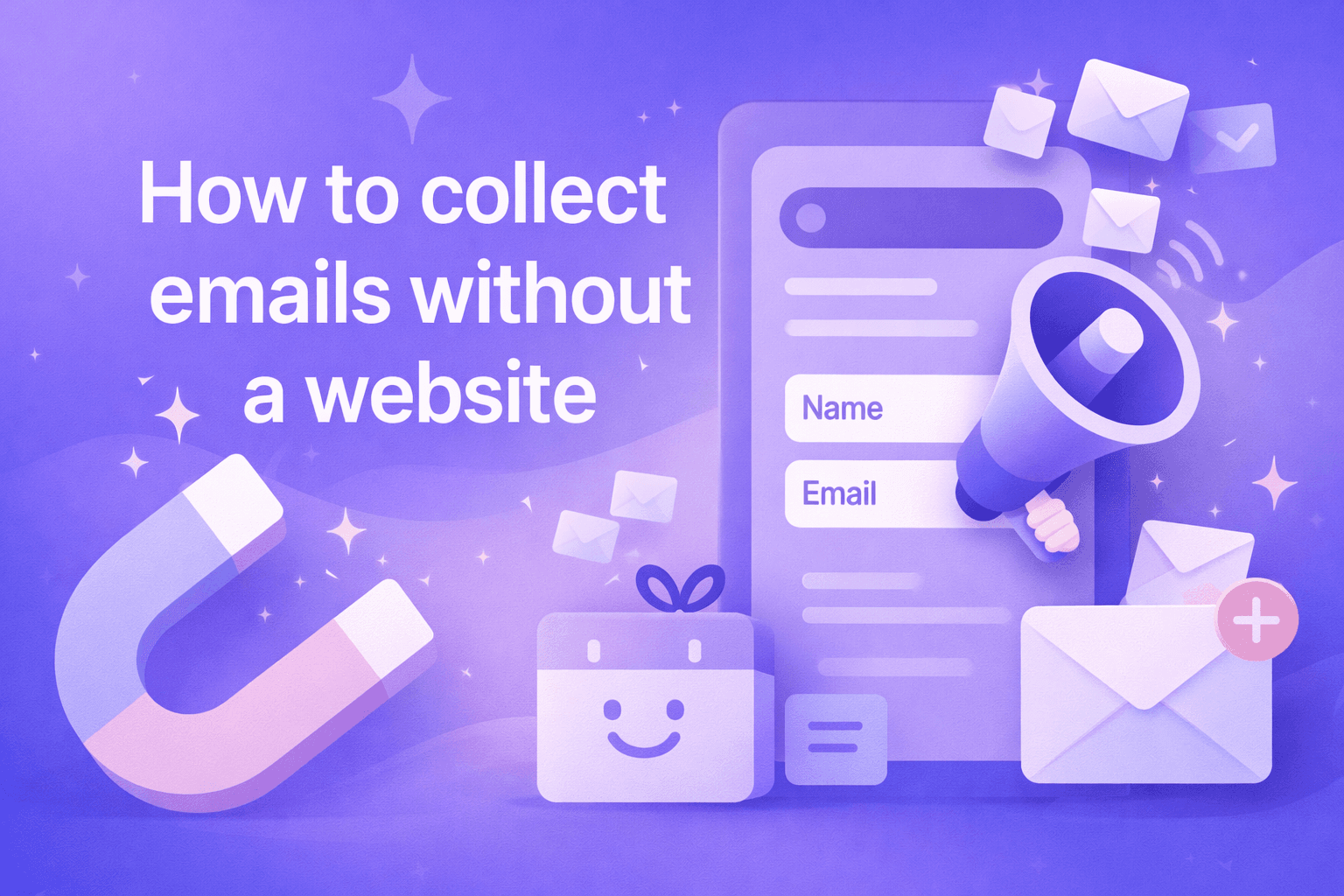
You want to start collecting emails. But you don't have a website.
Should you build one first?
No. You don't need a website to collect emails. In fact, for most creators and small business owners, a website is overkill when you're just starting out.
In this guide, you'll learn three practical ways to collect emails without any website at all. We'll cover what actually works, what to avoid, and how to set everything up in minutes instead of weeks.
Let's start with why this matters.
Why You Don't Need a Website for Email Collection
Here's a common misconception: to collect emails professionally, you need a website with forms, landing pages, and integrations.
Today, this is no longer required.
What you actually need is much simpler:
- A place to host your content or lead magnet
- A way to capture email addresses
- Instant delivery to the person who signed up
You can have all three without building a single webpage.
Think about how people share content now. A link in an Instagram bio. A QR code on a business card. A URL in an email signature. These all work perfectly for email collection—no website required.
Building a website takes time. You need to choose a platform, set up hosting, design pages, learn how forms work, and connect everything to an email service. For many people, that becomes a project that drags on for months.
Meanwhile, your potential leads are waiting. What matters most is fast, clear value delivery.
That's what we're solving today.
According to HubSpot's 2024 Marketing Report, 50% of marketers who use lead magnets report higher conversion rates. You don't need a fancy website to tap into that—just a simple system that works.
Method 1: Link-Based Lead Magnets (Recommended)
This is the approach we recommend for most people because it's straightforward, professional, and works everywhere.
How it works:
You upload your content (PDF, video, template, anything valuable) to a delivery tool. The tool gives you a shareable link. When someone clicks that link, they land on a clean page where they enter their email. They get instant access to your content. You collect their email automatically.
That's it.
Why this works:
The link works anywhere you interact with people:
- Social media bios (Instagram, TikTok, LinkedIn, X)
- Email signatures
- Business cards with QR codes
- Direct messages
- YouTube descriptions
- Podcast show notes
- Speaking events
You create it once. It keeps running.
This works for any type of business, for example:
- Coaches sharing planning templates
- Real estate agents offering neighborhood guides
- Consultants providing assessment tools
- Creators distributing exclusive content
- Personal trainers sharing workout plans
What to look for in a tool:
When choosing a link-based delivery tool, make sure it provides:
- Instant access after signup (no "check your email" friction)
- Works as a single shareable link
- Email export or integrations with your email platform
- Basic branding control (logo, colors)
- Clean, professional pages
Setting this up:
Tools like Claimful handle this workflow. Upload your file or add a link to your content. Customize the page if you want. Get your shareable URL. Share it wherever your audience is.
After someone enters their email, they should receive instant access to your content. Most tools will also send them an email copy for their records. Your leads should be automatically added to your email list or available for export, so you can follow up without manual work.
The key advantage: You're not locked into one platform or location. Your link works everywhere. And when you're ready to add more lead magnets later, you can create new links without touching any code.
Reality check: A simple lead magnet plus delivery link can be live in an afternoon. A website often takes weeks. For a deeper dive into what makes lead magnets work, check out our complete lead magnet guide.
Method 2: Social Media Native Tools
Most major platforms now offer some kind of email collection feature built directly into their interface.
What's available:
Instagram and Facebook have native lead forms that appear directly in the app. LinkedIn has lead gen forms for ads. Some platforms also offer similar lead form options, depending on region and account type.
How they work:
People can submit their email without leaving the platform. This reduces friction since they don't click external links.
The trade-offs:
These tools work, but they come with limitations:
- You can't deliver a file or resource automatically. When someone submits their email through an Instagram form, you still need to manually send them whatever you promised. That doesn't scale well.
- Your leads live inside the platform. You need to export them regularly and hope the platform doesn't change its terms.
- The forms are basic. You can't customize the experience much or brand them to match your style.
When this makes sense:
If you're running paid ads on these platforms and want to capture leads directly in the ad experience, native forms work well for that specific use case.
Verdict: Best for paid ads, not ideal for organic lead magnets.
Method 3: Direct Email Collection Tools
The third option is using form builders that collect emails but don't require a full website.
Common tools:
Google Forms is the most basic version. Typeform and Tally are more polished options. These let you create forms that collect information and email it to you.
How this works:
You create a form, get a link, share it. People fill it out. You get notified.
The challenge:
Someone submits their email... then what? You need to manually send them the lead magnet you promised. Every single time.
This is fine if you're getting 3-5 submissions per week and want complete control. But it breaks down quickly as you grow.
A better hybrid approach:
Some people use these forms to collect emails, then use automation tools like Zapier to connect them to email platforms or delivery systems. This works but adds complexity.
If you're comfortable with that level of setup, it's an option. But most people looking to collect emails without a website want something simpler. For a comparison of dedicated tools, see our lead magnet delivery tools guide.
Verdict: Fine for very low volume, but breaks with scale.
What to Avoid When Collecting Emails Without a Website
Before we get into the setup steps, here are the common mistakes that kill email collection systems:
Don't promise a resource and delay delivery. When someone gives you their email, they expect immediate access to what you offered. Instant access usually converts better.
Don't manually send lead magnets long-term. This works for your first 10-20 leads. Automation becomes necessary if you want to scale beyond a handful of subscribers per week.
Don't rely on platform-native tools without exporting leads. If Instagram or Facebook changes their terms tomorrow, you could lose access to your entire list. Export regularly or use a system where you own the data from day one.
Don't collect emails without a follow-up plan. The email address itself has minimal value. The relationship you build through follow-up emails is what converts leads into clients or customers.
Don't overbuild before validating demand. Start with the simplest possible setup. One lead magnet. One delivery method. See if people actually want what you're offering before investing in complex funnels or expensive tools.
Setting Up Your First No-Website Email System
Let's walk through the practical steps to start collecting emails today using the link-based approach.
Step 1: Create Something Worth Exchanging an Email For
First, you need a lead magnet—something valuable you'll give away in exchange for an email address.
This doesn't need to be complicated. Think about one specific problem your audience has. Create something that helps solve it.
Formats that work:
- A PDF template they can use immediately
- A checklist that saves them time
- A short video training (10-15 minutes)
- A resource list or tool kit
- A calculator or planning worksheet
Don't overthink this. Your first lead magnet doesn't need to be perfect. It needs to be useful.
Time investment: Most people can create a valuable lead magnet in 2-4 hours. A Google Doc template, a Canva PDF, or a quick Loom video. Keep it focused on solving one specific problem.
Step 2: Choose Your Delivery Method
Now you need a way to deliver this lead magnet and capture emails automatically.
Based on what we covered earlier, the link-based approach works best for most people. Choose a tool that meets the criteria we outlined: instant access, single shareable link, email export, and basic branding.
Upload your file or add a link to your content. Customize the page if you want (add your logo, change colors, write a description). Publish it and get your shareable link.
Make sure the system sends an email confirmation to the person who signed up. This gives them a backup copy and confirms their subscription worked.
Step 3: Share Your Link Strategically
Now it's time to promote your lead magnet. Start with the places you already have attention:
Social media profiles: Add the link to your Instagram bio, TikTok profile, LinkedIn about section, or YouTube description. One link that everyone can access. (For Instagram-specific strategies, see our guide to collecting emails on Instagram.)
Email signature: Add it as a P.S. in your email signature. Every email you send becomes a potential lead capture opportunity.
Content mentions: Reference it naturally when you create content. "I made a free template for this, link in bio." Keep it casual and helpful, not pushy.
Business cards and QR codes: If you network in person, add a QR code that links to your lead magnet. People can scan and access it immediately.
Direct messages: When someone asks you a question your lead magnet answers, share the link. You're being helpful and collecting an email at the same time.
The key is consistency. Don't just mention it once. Reference it regularly across all these channels for at least 60-90 days.
Step 4: Follow Up Consistently
Getting someone's email is just the beginning. The real value comes from the follow-up.
A simple 3-email minimum sequence:
Email 1 (Within 24 hours): Send a personal check-in. Ask if they found the resource helpful. Offer to answer questions. Keep it conversational.
Email 2 (3-5 days later): Provide additional value. Tips related to the lead magnet. Common mistakes. A quick win they can apply today.
Email 3 (7-10 days later): Introduce your paid offering naturally. "Now that you've used the [template], you might be wondering about [next logical step]. That's exactly what I help clients with."
Consistency matters more than polish. A plain text email sent on schedule beats a beautifully designed newsletter that never ships.
Follow-up matters more than tool choice. The best delivery system in the world won't convert leads if you never email them again.
This approach builds trust before asking for anything. And trust converts.
Common Questions About Website-Free Email Collection
"Is this professional without a website?"
Yes. What matters most is fast, clear value delivery.
When someone lands on a clean page, gets your lead magnet instantly, and receives helpful follow-up emails, they think "this person helped me solve a problem." Professionalism comes from quality, not complexity.
"Can I scale this approach?"
Absolutely. The link-based method scales extremely well. Whether 10 people or 10,000 people click your link, the system works the same way.
Eventually you might want a website for other reasons—showcasing your full portfolio, adding a blog, building more complex funnels. But for pure email collection, a link system can handle serious volume.
"What about landing pages?"
Landing pages are just dedicated web pages designed for one specific conversion goal—usually email capture.
The link-based approach we described essentially creates a landing page for you without requiring any website. You get the benefit (focused page, clear call-to-action, email capture) without the complexity of building and hosting it yourself.
"When should I build a website?"
Build a website when you need features that simple tools can't provide:
- Multiple service pages with detailed information
- A blog or resource center
- Portfolio galleries
- Complex booking systems
- E-commerce functionality
But if you just need to collect emails and deliver lead magnets, start with a link-based system. You can always add a website later.
Many successful coaches, consultants, and creators run their entire business on link-based systems for years before investing in a full website.
Start Simple, Start Today
The biggest mistake people make with email collection is waiting for the "perfect" setup.
They wait to build a website. Wait to learn complicated tools. Wait to create the perfect lead magnet. Meanwhile, potential leads are slipping away.
Here's what actually works:
Create one lead magnet this week. Something that solves a real problem your audience has. Upload it to a delivery tool. Get your link. Share it everywhere you already show up.
That's it.
Will it be perfect? Probably not. But a lead magnet that exists and collects emails is infinitely more valuable than a perfect system you never launch.
Start with this. Collect your first 50-100 emails. Learn what your audience responds to. Refine your approach. Add a website later if you need one.
Create one link, share it everywhere, and start collecting emails today.
Get started free with Claimful
Want niche-specific ideas? Check out our lead magnet guides for real estate agents, creators and influencers, and personal trainers. Or dive into our complete lead magnet guide for everything you need to know.